Wake Tender & Guest Tow Operations
A four-level certification programme that takes your tender team from safe, repeatable beginner delivery through to supporting intermediate and advanced riders.
Four levels, one standard
We have written a four-level Wake Tender and Guest Tow Operations course series. It runs onboard, it is assessed by written and practical exam, and it produces paperwork you can keep on file.
Early levels are about the boat: handling, towing, wake setup, pickup protocol and rescue. Later levels add progressively more coaching content, until crew can genuinely support guests rather than just drive for them.
Crew leave with a certificate and a badge. The yacht keeps the manuals, presets, quick-reference cards and competency records, so rotations stop being a risk and the boat performs the same way whoever is on watch.
Knowledge decays with every rotation
Crew rotations are frequent. Without a structured programme, knowledge walks off the boat and standards drift.
You end up with a tender that's only ever a shuttle, guests who don't get any better, and a safety picture that changes depending on who happens to be driving.
We install a repeatable playbook and refresh it on a cycle, just as you would for any other high-standard area of the yacht.
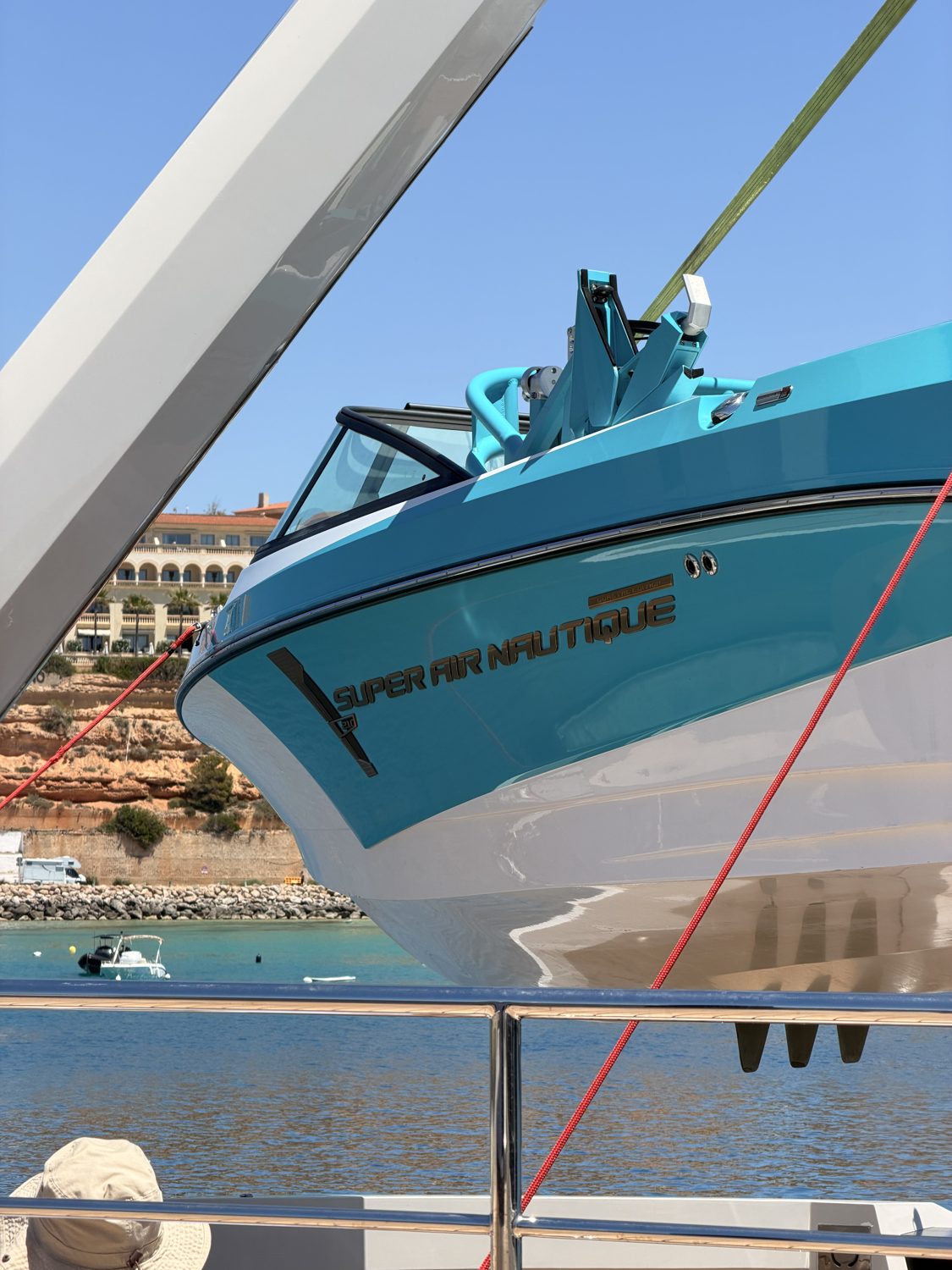
Launch and recovery
Most of the risk sits at either end of the session. Getting the boat off the yacht and back on it, in a swell, with guests watching, is where a trained crew earns its keep.
Levels 1 to 4
Operator
The foundation. V-drive handling, towing patterns, wake setup, pickup protocol, rescue and gear care. Very little coaching content at this stage. The aim is a calm, safe session that runs the same way every time.
Advanced operator
The same disciplines under pressure: more demanding sea states, mixed-ability groups, and higher-tempo guest rotation.
Setup specialist
Deeper wave engineering and equipment matching, so the boat can be tuned to the rider rather than left on a preset.
Coaching operator
Mostly coaching, aimed at intermediate to advanced riders. Crew learn to teach rather than just support, so guests keep improving between our visits.
Full syllabi are issued on request. Most yachts start the whole tender team at Level 1.
What the foundation covers
All about the boat and the safety envelope around it. There is very little coaching content by design. Get the driving and the setup right and beginner sessions run themselves.
Handling & docking
Low-speed control, forward and reverse behaviour, station keeping, docking and departure patterns, close-quarters safety.
Driving & tow control
Smooth pull-ups, throttle micro-control for line tension, tow line geometry, turnaround patterns and corridor management.
Water strategy
Finding clean lines, roller avoidance, reset timing, and traffic management in busy anchorages.
Stopping & pickup
Normal and emergency stop discipline, engine-stop protocol on rider pickup, and the non-negotiables near a rider in the water.
Wake building & setup
What actually builds a wave: ballast, surf systems and wake devices, preset creation, and fast troubleshooting when it isn't working.
Communication
Standard hand signals, confirmation loops, observer callouts, radio discipline and group management.
Platform choreography
Rider entry and exit sequences, rotation flow, and keeping the transom calm and orderly with guests aboard.
Rescue & injury recovery
Deep water recovery for a towed rider, injury scenarios, scene control under stress, and cold and fatigue stop rules.
Saltwater operations & gear care
How salt changes the job, rinse and inspection routines, and storage and readiness standards.
Entry standard
Captain-approved tender operator baseline. We recommend PB2-level handling competence or an equivalent sign-off before Level 1.
Onboard, around your day
Delivered onboard over a small number of focused days, planned around the best water window. Group sizes are kept small so assessment stays meaningful.
Theory & practical
A written theory test plus a practical examination covering docking, towing patterns, setup, pickup and rope handling, rescue scenarios, communications and platform flow.
What stays onboard
- Crew. Completion certificate and badge.
- Yacht. Course manuals and quick-reference cards.
- Presets sheet and rescue quick-flow.
- Audit-ready sign-off notes.
- Crew competency records and practical score sheets for onboard files.
The same result every trip
Operations run more smoothly, the wave is there when you want it, kids' sessions are calmer, and it holds up whoever is on watch.
The tender team uses the same calls and the same sequence, so you get the same result on every trip.
Roberts Linavskis
A multi-time European medallist and IWWF Masters World Wakeboard Champion, who has trained hundreds of riders and teams and pioneered luxury wake experiences in Europe.
Tell us your dates and cruising plan
Send us the itinerary, what tender you have, and who's riding. We'll come back with a coach, a gear plan and a rough shape for the week.